
Selecting the right thermoelectric (Peltier) module starts with your thermal requirements, not with the catalogue. This guide walks through the questions to answer, the four selection steps, and a worked example — then shows how to find the equivalent EVERREDtronics module.
Start with these questions
Before selecting a module, answer the questions below (after Ferrotec, Technical Reference Guide §9.1):
- At what temperature must the cooled object be maintained?
- How much heat must be removed from the cooled object?
- Is thermal response time important?
- What is the expected ambient temperature, and will it change significantly?
- What is the extraneous heat input (heat leak) from conduction, convection and radiation?
- How much space is available for the module and heat sink?
- What power is available?
- Must the temperature be controlled, and to what precision?
- What is the expected heat-sink temperature during operation?
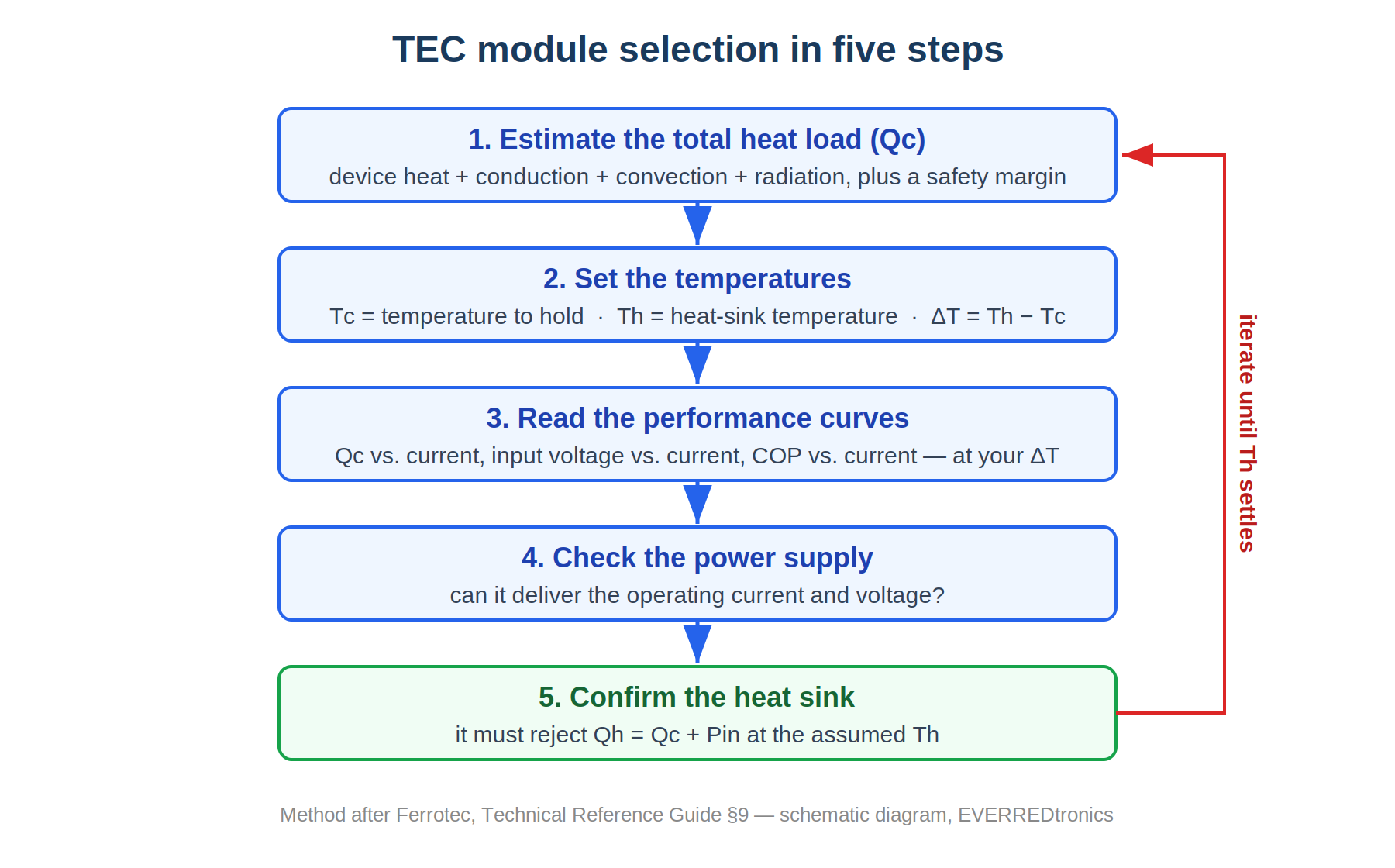
Selection is iterative: module performance depends on the operating temperatures, the heat load and the heat sink together, so the numbers are usually recalculated until the hot-side temperature settles.
The four steps
- Estimate the total heat load (Qc) — active heat from the device plus heat leak through conduction, convection and radiation. Add a safety margin.
- Set the temperatures — cold-side temperature Tc (the temperature you must hold) and hot-side temperature Th (what your heat sink can maintain). The temperature differential is ΔT = Th − Tc.
- Read the performance curves — for a candidate module, check Qc vs. current, input voltage vs. current, and COP vs. current at your ΔT. Performance graphs are usually referenced to Th = 50°C and are usable over roughly 40–60°C with only a slight error (Ferrotec §9.2).
- Check the power supply — confirm it can deliver the operating current and voltage, and that the heat sink can reject Qc plus the module’s input power.
Worked example — cooling a small electronic enclosure
Adapted from Ferrotec, Technical Reference Guide §9.3 (figures as published by Ferrotec; our standard modules are specified the same way — see the Standard Thermoelectric Modules table).
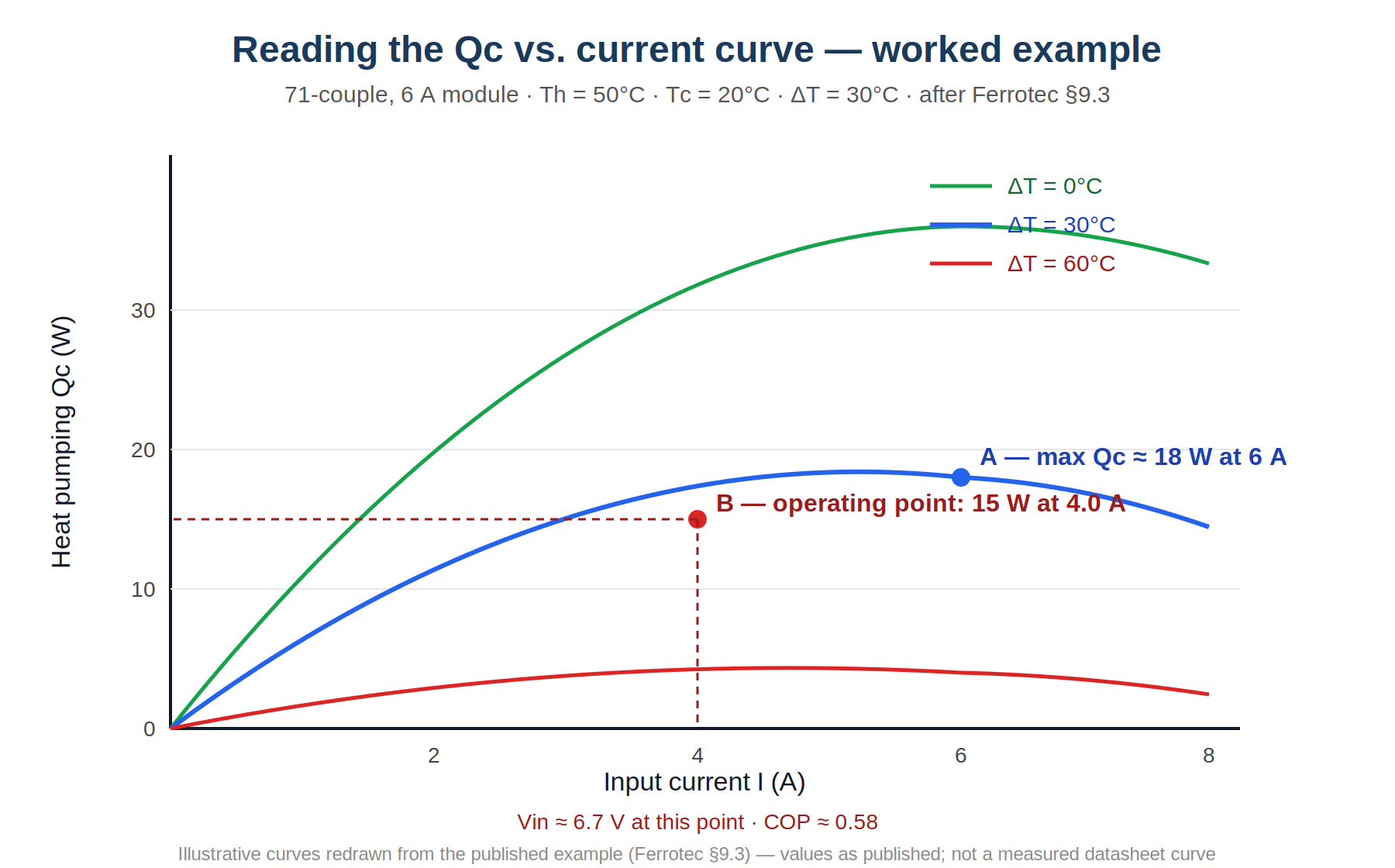
A small electronic “black box” dissipates 15 W and must not exceed 20°C. The heat sink can be maintained at 50°C under worst-case conditions, so ΔT = 50 − 20 = 30°C. A 71-couple, 6-ampere module is investigated:
- From the Qc vs. current curve at ΔT = 30°C, the module can pump about 18 W at 6 A. Following the ΔT = 30 line down to the required 15 W gives the operating point at about 4.0 A.
- From the input voltage vs. current curve at ΔT = 30°C and 4.0 A, the required input voltage is about 6.7 V.
- From the COP vs. current curve, the coefficient of performance at that point is about 0.58.
A second, fuller design example in the same guide (§9.5) stabilises a laser diode at 25°C (0.5 W dissipated, 35°C ambient, housing thermal resistance 6°C/W) with an 18-couple, 1.2 A module, iterating the hot-side temperature until it settles — the same iterative method applies to any TEC selection.
Find the equivalent EVERREDtronics module
Match the example’s requirements against our Standard Thermoelectric Modules table by Qcmax, ΔTmax, footprint and Imax/Vmax. If a single stage cannot reach your ΔT, see our multi-stage modules; if no standard size fits, see our custom thermoelectric modules. If you send us the target cold-side temperature, the heat load and the hot-side temperature you can hold, we will confirm the module for your duty point.
Sources
- Ferrotec, Technical Reference Guide, §9 “Thermoelectric Module Selection” — selection questions, performance-graph method, and the worked examples in §9.3 and §9.5.
- TE Technology, Module Calculator Instructions — instructions for the Peltier module selector program: iterative module selection by operating temperatures, heat load and ΔTmax.
- Standard Thermoelectric Modules table — Qcmax 1.6–480 W, sizes 10×10–80×120 mm, parameters at Thot = 30°C.
The temperature the cooled object must hold, the heat to remove, the ambient temperature, the heat leak, the space available, the power available, and the heat-sink temperature you can maintain.
Because the hot-side temperature depends on the heat the module rejects, which depends on the module chosen. The calculation is repeated until the hot-side temperature stops changing.
Qcmax is the maximum heat-pumping capacity at ΔT = 0. In practice you operate below it, at your ΔT, with a safety margin on the heat load.
Yes. Send us the target cold-side temperature, the heat load and the hot-side temperature you can hold, and we will confirm the module for your duty point.