
Thermoelectric generation turns industrial waste heat into electricity with no moving parts, no noise and no vibration. EVERREDtronics supplies the thermoelectric generator (TEG) modules at the heart of these systems, and supports project partners with module selection and system matching.
We have already been part of a project that reached commercial operation: a 10 kW-class waste-heat power generation system, demonstrated at a steelmaking plant in Japan and now offered as a commercial product. Few thermoelectric projects anywhere have reached this stage, and the experience is directly relevant to your project.
A 10 kW-class system, now a commercial product
The system recovers heat from industrial exhaust gas and converts it into electricity. Each generation unit produces around 2 kW [8]; units are installed in tandem, so output scales with the size of the heat source. A four-unit system delivers 9.5 kW of AC power and avoids about 30 tonnes of CO2 emissions per year [9]. Units can be installed one at a time, starting from a single unit [10].
The system was demonstrated in long-term operation at a steelmaking plant in Japan from 2018 to 2021, as part of a project commissioned by Japan’s Ministry of the Environment [9]. In January 2025, the project owner announced the system’s commercialization and exhibited a real unit at ENEX2025 in Tokyo [10]. The system is now offered as a commercial product.
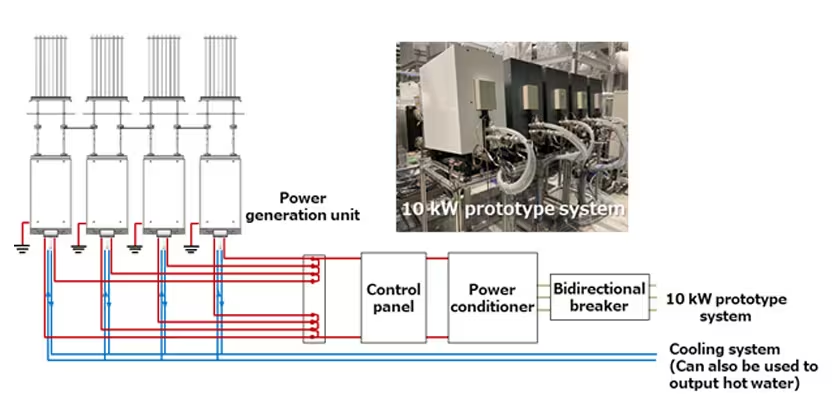
- Output: 9.5 kW AC (four units); around 2 kW per unit; installable from a single unit
- Exhaust gas temperature: 350–800 °C
- CO2 reduction: about 30 tonnes per year (four-unit system)
- Expected operating life: 10 years or more
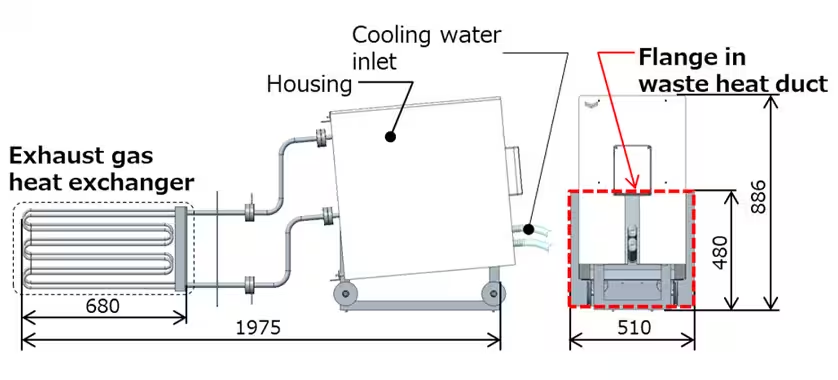
- Installation: bolt the duct flange to the exhaust duct, connect cooling water and wiring — three steps
- Unit weight: 130 kg; duct connection 510 × 480 mm
- Grid connection: three-phase 200 V AC via power conditioner; hot water supply also available
Sources: [8][9][10].
EVERREDtronics supplied the TEG modules for this system — the power-generating elements that convert the recovered heat into electricity — with custom modules built for the system’s operating conditions, and supported module selection and system matching throughout the project.
This has been a long-term partnership, running since 2017 and still ongoing. Our modules for the project have gone through four major iterations, plus countless smaller refinements — each round matching the customer’s evolving requirements and meeting strict durability testing and stable-output requirements. That iteration history is part of what we bring to a new project: modules proven not just on a datasheet, but through years of real operating demands.
How the system works
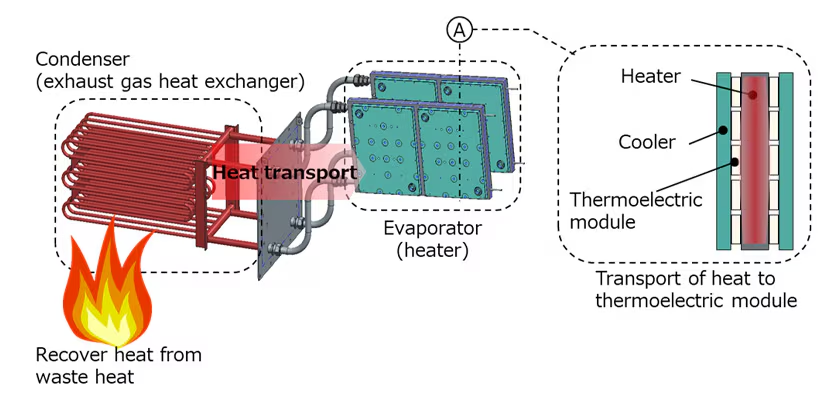
A loop thermosiphon heat exchanger recovers heat from the exhaust duct: the working fluid evaporates, travels to the heater, and condenses, releasing its latent heat to the thermoelectric modules [8]. The modules convert the temperature difference directly into DC electricity, which a power conditioner converts to AC for the grid. With no moving parts, the system runs quietly and needs little maintenance. A sandwich configuration — heater in the centre, modules on either side, coolers outside — keeps thermal stress low and supports a service life of more than 10 years [8].
Waste heat to power: a large opportunity — with challenges being solved
Industry throws away an enormous amount of energy as heat. The U.S. Department of Energy estimates that 20–50% of industrial energy input is lost as waste heat — through exhaust gases, cooling water and hot surfaces [1]. Analysts put the thermoelectric generator market at around US$1 billion in 2025, growing to roughly US$1.4–1.7 billion by 2030 [2][3].
Not all of that heat can be recovered economically — much of it is too cool, too dispersed, or too far from anyone who could use it. That is exactly why project selection and system design matter more than the module alone. Thermoelectric generation fits where other technologies do not: it is compact, has no moving parts, bolts onto an existing exhaust duct, and scales by adding units — places where a steam turbine or ORC system would be too large, too complex or uneconomic. And the technology is no longer a laboratory promise: kW-class systems are in commercial operation today.
The challenges are real — but each one has a working answer today, and a better one on the way:
- Conversion efficiency is modest — but the fuel is free. Commercial thermoelectric systems convert roughly 5–8% of the heat into electricity [5]. Since the heat would otherwise be thrown away, the economics turn on cost per watt and payback — not on efficiency alone. Good system design raises real-world output: high-capacity heat exchangers, such as loop thermosiphon designs, deliver more heat to the module at a higher temperature difference [8]. And next-generation materials — skutterudites, half-Heusler alloys, segmented elements — have reached 10–12% in the laboratory and are moving toward production [5].
- Cost per watt has fallen sharply — and keeps falling. In the mid-2000s, commercial TEGs cost about US$30 per watt, and the U.S. DOE set a US$5 per watt target for industrial viability [7]. Current industry estimates put TEG costs at roughly US$1–5 per watt depending on application [4]; in our manufacturing experience, industrial TEG modules are now typically US$3–5 per watt. At system level, installed costs of US$1,500–5,000 per kW are commonly cited, with payback of roughly 3–7 years in continuous industrial operation [6]. Published figures vary with scope — module-only versus installed system, application and volume — but the direction is consistent: costs have fallen by roughly an order of magnitude since the mid-2000s.
- Materials have temperature limits — so match the material to the heat. Commercial modules are mostly bismuth telluride (up to about 250 °C) and lead telluride (250–600 °C) [5]. The answer today is selecting the right material for each temperature band and designing the system around it — which is what experienced suppliers do. Looking ahead, tellurium-free and low-tellurium materials such as magnesium silicide, and higher-temperature skutterudites, are in active development, widening the usable range and easing supply risk [5].
- Integration is the hard part — and it has been solved in practice. Moving heat to the module, managing thermal cycling over a 10-year life, and conditioning the electrical output decide whether a system survives in a real plant. The answers are proven system designs: heat exchangers that heat the modules evenly and densely, sandwich configurations that keep thermal stress low, and long-term demonstration in real operating conditions. The project above is the evidence [8].
The opportunity is large, the technology is proven at kW scale, and the remaining challenges are engineering problems with known solutions — not open questions.
What EVERREDtronics provides for projects
- Project evaluation — preliminary feasibility: we assess whether your waste-heat source, temperatures and operating hours make a thermoelectric project viable, before you commit to detailed design.
- TEG modules: standard range plus custom modules built for your operating temperatures and mechanical constraints.
- Module selection and system matching: help sizing the module array to your heat source and target output.
- Technical consulting: module and system advice throughout the project, from first evaluation to commissioning.
- Long-term supply: a manufacturer with its own production lines, not a trader — the same modules, batch after batch.
- Regular progress communication: scheduled updates at agreed milestones, so you always know where the project stands.
Start a project with us
To evaluate your waste-heat project, we need a few key facts about your heat source. The more precise the information, the more accurate our preliminary assessment.
Checklist — what to send us, and why:
- Heat source — exhaust gas temperature and flow rate, or the process involved: sets how much power the system can generate and which module materials suit the temperature range.
- Operating hours per year: determines annual electricity output and the payback period.
- Target power output: sizes the module array and the number of generation units.
- Space available around the duct: decides how many units fit and how the system is laid out.
- Cooling water supply — temperature and flow rate: the cold-side temperature sets the temperature difference across the modules, which drives output.
- Exhaust gas composition — sulfide and chloride levels: affects heat-exchanger material choice and long-term durability.
- Electricity price, or what the generated power is worth to you: determines project economics and payback.
Send us the information above through our contact page, and we will come back with a preliminary feasibility assessment.
Frequently asked questions
Yes. A single module produces watts, but modules are assembled into units of around 2 kW, and units are installed in tandem. A four-unit system delivers 9.5 kW AC, and output scales with the size of the heat source.
Industrial exhaust gas at 350–800 °C, such as furnace exhaust. Gas combustion exhaust is suitable; sulfide and chloride concentrations should each be 100 ppm or below.
Commercial systems convert roughly 5–8% of the heat into electricity [5]. Because the heat is waste that would otherwise be lost, what matters for a project is cost per watt and payback period — not efficiency alone.
The TEG modules — standard or custom — plus module selection and system-matching support. System integration, installation and grid connection are handled by the project owner or its engineering partners.
The system is designed for an operating life of 10 years or more. With no moving parts, there is no mechanical wear, no noise and no vibration.
References
- U.S. Department of Energy, Waste Heat Recovery: Technology and Opportunities in U.S. Industry, 2008.
- Mordor Intelligence, Thermoelectric Generator Market – Growth, Trends, and Forecast (2025–2030), 2025.
- MarketsandMarkets, Thermoelectric Generator Market – Global Forecast to 2030, 2025.
- Woodstone Research & Consulting, Thermoelectric Generators Market Size, Share & Forecast 2026–2033.
- PatSnap Eureka, Thermoelectric Waste Recovery Integration with Renewable Energy Systems, October 2025.
- PatSnap Eureka, Calculating System-Level Economics and Payback Periods for Thermoelectric Generators in Waste Heat Recovery, August 2025.
- T. Hendricks, Engineering Scoping Study of Thermoelectric Generator Systems for Industrial Waste Heat Recovery, Pacific Northwest National Laboratory for the U.S. Department of Energy, November 2006.
- Project owner’s published technical review of the kW-class thermoelectric power generation system, 2022. Customer name withheld under a confidentiality agreement.
- Project owner’s product documentation for the thermoelectric power generation system, 2022–2025. Customer name withheld under a confidentiality agreement.
- Project owner’s press release on the commercialization of the thermoelectric power generation system, January 2025. Customer name withheld under a confidentiality agreement.